

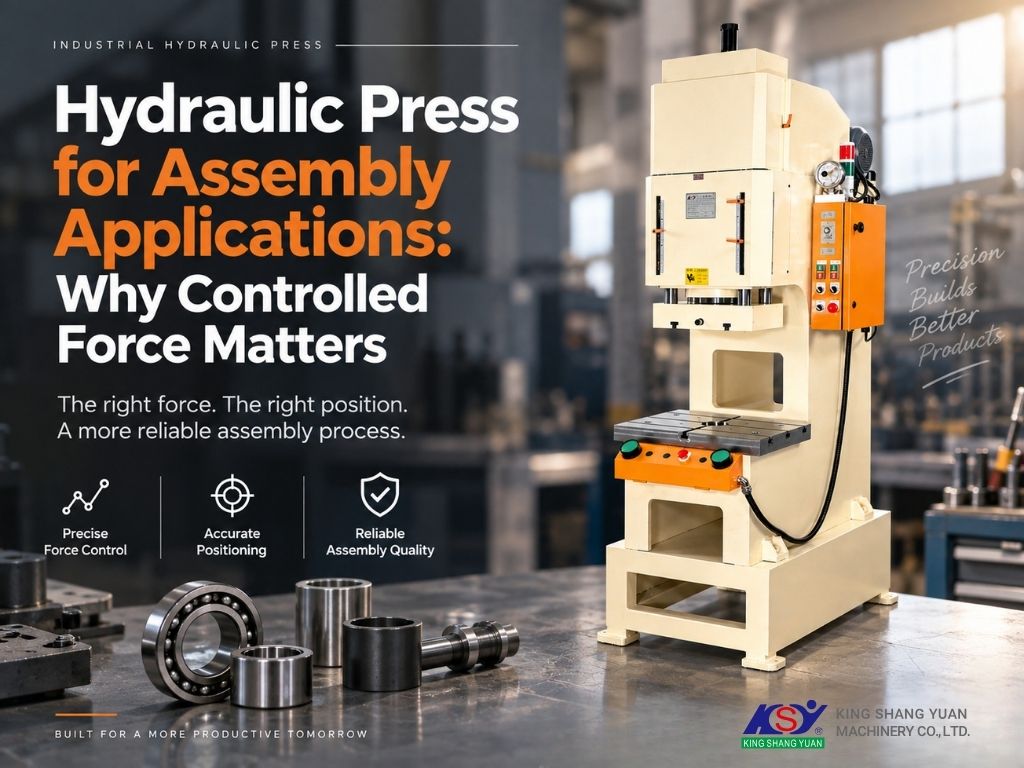
In assembly operations, applying force is easy. Applying the right amount of force, at the right position, with consistent results is much more important.
Components such as bearings, bushings, shafts, pins, sleeves, and other press-fit parts often depend on controlled force during assembly. Too little force may result in incomplete seating or loose fits, while excessive force can deform components, damage mating surfaces, or affect assembly quality.
For manufacturers evaluating a hydraulic press for assembly applications, machine selection should therefore go beyond maximum tonnage. At King Shang Yuan Machinery Co., Ltd., we focus on hydraulic press solutions that allow manufacturers to adjust pressure and press position according to actual production requirements.
This article explains why controlled force matters in assembly processes, how force and position influence assembly quality, and what manufacturers should consider when selecting a hydraulic press.
Table of Contents
- What Is a Hydraulic Press Used for in Assembly?
- Why Controlled Force Matters in Press-Fit Assembly
- What Happens If Too Much Force Is Applied During Assembly?
- What Happens If Pressing Force Is Too Low?
- Why Does Bottom Dead Center Position Matter in Assembly?
- How Stable Hydraulic Pressure Improves Assembly Repeatability
- Why Tooling and Alignment Matter in Press-Fit Assembly
- What Should You Check When Selecting a Hydraulic Press for Assembly?
- King Shang Yuan Hydraulic Press Solutions for Assembly Applications
- When Should You Consider a Hydraulic Press for Assembly?
- Conclusion
- FAQ
- Further Reading
What Is a Hydraulic Press Used for in Assembly?
A hydraulic press for assembly uses hydraulic pressure to generate controlled force for joining, inserting, fitting, or positioning components during manufacturing.
Typical processes include bearing insertion, bushing installation, shaft and sleeve assembly, pin insertion, riveting, hardware assembly, and other press-fit operations.
Unlike punching or cutting, however, the objective of an assembly operation is not simply to generate enough force to complete the process. The press must move the component into its intended position without unnecessarily stressing the part, mating component, or surrounding structure.
This is why the suitability of an assembly press depends not only on available tonnage, but also on how effectively its pressure and final pressing position can be adjusted for the workpiece.
Why Controlled Force Matters in Press-Fit Assembly
Controlled force helps manufacturers achieve the required fit while reducing the risk of incomplete assembly, excessive loading, and component damage.
Consider a bearing being pressed into a housing. The required force changes according to factors such as component dimensions, interference, material properties, surface condition, and tooling arrangement.
If the applied force is insufficient, the bearing may stop before reaching its intended position. If excessive force continues to be applied after the bearing is seated, the bearing, housing, or related components may be damaged.
The same principle applies to bushings, shafts, pins, sleeves, and other interference-fit parts.
For this reason, manufacturers should not treat maximum press tonnage as the target force for every assembly. The available capacity of the hydraulic press and the force actually required by the process are two different things.
What Happens If Too Much Force Is Applied During Assembly?
Excessive pressing force can deform components, damage mating surfaces, distort housings, and reduce the dimensional consistency of the finished assembly.
This is particularly important when a relatively delicate component is being inserted into a stronger structure. A hydraulic press may have significantly more available capacity than the assembly process actually needs, so simply operating at maximum force provides no production advantage.
Instead, hydraulic pressure should be adjusted according to the actual assembly requirement. This gives manufacturers greater control over the process and reduces the risk of applying unnecessary loads to the workpiece.
In other words, the question is not simply “Can this press generate enough force?” but also “Can the force be adjusted appropriately for this component?”
What Happens If Pressing Force Is Too Low?
Insufficient pressing force can prevent a component from reaching its specified seating position, resulting in incomplete assembly and dimensional variation.
A component may appear to have been installed correctly but stop slightly above its required position. This can lead to incorrect alignment, loose assemblies, downstream assembly problems, or additional rework.
Visual inspection alone may not always reveal this type of problem, particularly when the difference in insertion depth is small.
For this reason, a stable assembly process should consider both required force and final position. Force helps complete the press-fit operation, while position determines whether the component has reached the intended assembly depth.
These two parameters should therefore be evaluated together rather than independently.
Why Does Bottom Dead Center Position Matter in Assembly?
Bottom dead center position helps control the final insertion depth of the component, making it an important parameter in assembly processes where the finished position must remain consistent.
When installing bearings, bushings, sleeves, pins, or other press-fit components, the finished assembly may require a defined insertion depth. If the press stops too early, the component may remain partially seated. If it travels unnecessarily far, excessive loading or deformation may occur.
Adjusting the bottom dead center position allows the press movement to be configured according to the required assembly depth.
This becomes particularly valuable in repeat production. Once appropriate pressure and position parameters have been established, the same operating conditions can be used to improve consistency between production cycles.
For manufacturers handling different workpieces on the same machine, adjustable press positioning also provides greater flexibility when changing from one assembly requirement to another.
How Stable Hydraulic Pressure Improves Assembly Repeatability
Stable hydraulic pressure helps maintain more consistent pressing conditions across repeated assembly cycles, reducing operator-dependent variation and supporting process repeatability.
A successful assembly process must work consistently—not only for the first component, but across hundreds or thousands of production cycles.
Manual assembly methods can introduce variation because the result may depend heavily on operator technique. A properly configured hydraulic press provides a more controlled operating sequence, helping manufacturers standardize the way force is applied.
For example, when pressure and press position are set according to the workpiece, operators do not need to judge the required pressing conditions independently during every cycle. This can reduce operator-dependent variation and make finished assembly quality more predictable.
Stable hydraulic operation is therefore not only about protecting individual components. It also contributes to process repeatability, reduced rework, and more consistent production quality.
Why Tooling and Alignment Matter in Press-Fit Assembly
Correct tooling and alignment ensure that pressing force is transferred along the intended assembly axis rather than being concentrated unevenly on the workpiece.
Even precise pressure control cannot compensate for poor tooling or incorrect workpiece alignment. If the component enters at an angle, the load can become uneven and cause tilted insertion, surface damage, premature tooling wear, or component deformation.
Tooling must therefore locate and support the workpiece correctly before the press cycle begins.
The location where pressing force is applied also matters. Bearing installation is a good example: the tooling and contact point must be selected according to the assembly arrangement so that inappropriate loads are not transferred through sensitive bearing elements.
A reliable press-fit process therefore depends on the combination of controlled force, controlled position, suitable tooling, and correct alignment. Increasing press tonnage cannot compensate for a problem caused by one of the other factors.
What Should You Check When Selecting a Hydraulic Press for Assembly?
When selecting a hydraulic press for assembly, manufacturers should evaluate required force, pressure adjustment, stroke, final press position, working space, tooling, controls, and production requirements together.
The required assembly force determines the necessary press capacity, but pressure adjustability determines whether that capacity can be appropriately controlled. Stroke and bottom dead center position affect how the component reaches its required final depth, while table dimensions must provide enough space for the workpiece, fixture, and tooling.
Production requirements also matter. A machine used occasionally for a single assembly process may have different control requirements from one handling multiple components throughout a production shift.
| Selection Factor | Why It Matters |
|---|---|
| Required Assembly Force | Determines suitable press capacity |
| Pressure Adjustability | Helps match pressing force to different workpieces |
| Stroke | Must accommodate the required press movement |
| Bottom Dead Center Position | Helps control final insertion depth |
| Working Table Size | Must accommodate the workpiece, tooling, and fixture |
| Tooling and Alignment | Helps ensure force is transferred correctly |
| Control Method | Influences operating consistency and flexibility |
| Production Requirements | Affects machine configuration and operating needs |
The best assembly press is therefore not necessarily the highest-tonnage machine. It is the press whose working capacity and adjustment capabilities correspond to the actual process.
King Shang Yuan Hydraulic Press Solutions for Assembly Applications
At King Shang Yuan, we understand that assembly applications require more than simply generating maximum pressing force. Our hydraulic machines are designed to provide manufacturers with adjustable operating parameters so the machine can be configured around different processing requirements.
Hydraulic pressure can be adjusted according to the workpiece, while punch head position and bottom dead center precision position can also be set based on the required operation. These functions are particularly relevant to assembly work because different components may require different combinations of force and insertion depth.
Our machines also provide automatic PLC control and two-hand button operation. For production environments involving longer operating periods, the hydraulic system incorporates oil-temperature cooling using fan cooling, helping maintain stable operating conditions while keeping the oil temperature from exceeding 48°C according to our machine design specifications.
Energy-saving operation and lower operating noise are additional considerations for manufacturers using hydraulic equipment as part of regular production.
Rather than recommending a hydraulic press based solely on its maximum tonnage, we evaluate the workpiece, material, fit requirement, tooling, required force, stroke, and production conditions together. This allows us to recommend a hydraulic press configuration that better matches the customer's actual assembly process.
You can explore our hydraulic press solutions to find equipment for different industrial production requirements.
When Should You Consider a Hydraulic Press for Assembly?
A hydraulic press is worth considering when an assembly process requires more consistent force, controlled insertion depth, reduced operator variation, or greater production repeatability.
For example, manufacturers may find that press-fit depth varies between operators, components occasionally deform during installation, or increasing production volume makes manual assembly increasingly difficult to standardize. Another common situation is when several product types must be assembled on the same production equipment but require different pressing conditions.
In these cases, introducing a hydraulic press with adjustable pressure and position can provide a more defined production process.
However, switching to hydraulic pressing does not automatically solve every assembly problem. Tooling, alignment, workpiece tolerances, and process parameters still need to be correctly established. The value of the hydraulic press comes from providing a controllable and repeatable platform on which that process can be built.
Conclusion
For assembly applications, hydraulic press performance should not be judged by maximum tonnage alone.
The real objective is to apply enough force to complete the assembly while reaching the correct position without placing unnecessary stress on the components. Pressure adjustment, bottom dead center positioning, tooling alignment, and stable hydraulic operation all contribute to achieving this balance.
From our perspective at King Shang Yuan Machinery Co., Ltd., the best hydraulic press for assembly is not necessarily the machine with the highest force capacity. It is the machine that can be configured appropriately for the customer's workpiece and production process.
If you are planning a press-fit, bearing insertion, bushing installation, or other industrial assembly process, contact King Shang Yuan with your workpiece drawings, material information, required assembly position, tooling details, and production requirements. We can help you evaluate a suitable hydraulic press solution.
FAQ: Hydraulic Presses for Assembly Applications
How much force is required for a press-fit assembly?
There is no single force value that applies to every press-fit operation. Required force depends on factors such as interference, component dimensions, materials, contact conditions, surface finish, and tooling. The actual assembly conditions should therefore be evaluated before selecting press capacity.
Why is bottom dead center adjustment important for assembly?
Bottom dead center adjustment helps control the final press position. This is particularly useful when a bearing, bushing, pin, sleeve, or other component must reach a defined insertion depth without unnecessary over-travel.
Is a higher-tonnage hydraulic press better for assembly?
Not necessarily. Higher tonnage only provides greater available force. Assembly quality depends on whether the press provides appropriate pressure adjustment, stroke, positioning, working space, and operating consistency for the actual component.
Further Reading
How to Calculate Whether a 50 Ton Hydraulic Press Is Enough for Your Application
Learn how to evaluate material properties, tooling, required force, stroke, working area, and safety margin before deciding whether a 50 ton hydraulic press provides sufficient capacity.
Why PLC-Controlled Hydraulic Presses Are Becoming Standard in Modern Factories
Explore how PLC control supports more consistent hydraulic press operation, easier parameter management, production efficiency, and automation integration.
How to Choose the Right Industrial Hydraulic Press for Your Production Line
Learn which factors should be evaluated when selecting an industrial hydraulic press, including capacity, working requirements, controls, and actual production conditions.