

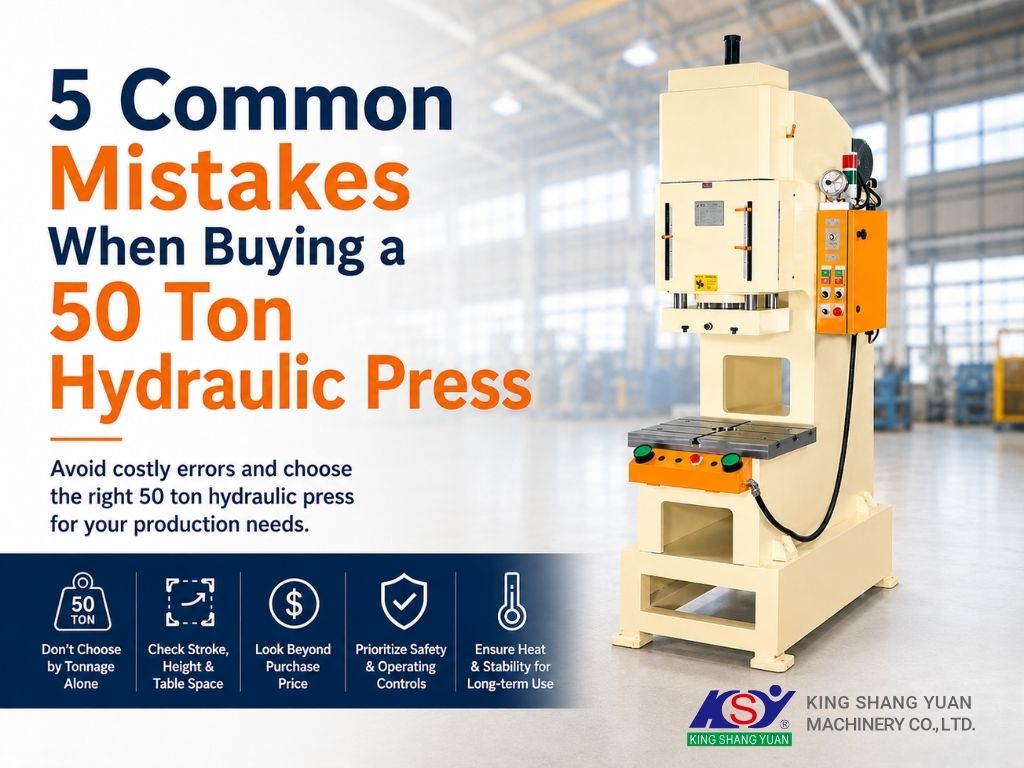
A 50 ton hydraulic press can be a versatile choice for industrial punching, forming, assembly, and other press operations. However, choosing the right machine involves much more than finding a model labeled “50 ton.”
Two machines with the same maximum force capacity may differ significantly in working space, stroke configuration, control method, operating stability, safety design, and suitability for the intended process.
At King Shang Yuan Machinery Co., Ltd., we believe press selection should begin with the actual production requirement rather than tonnage alone. Before purchasing a 50 ton hydraulic press, manufacturers should understand several common selection mistakes that can lead to poor machine fit, inefficient production, or unnecessary costs.
Table of Contents
- Mistake 1: Choosing a 50 Ton Hydraulic Press Based on Tonnage Alone
- Mistake 2: Ignoring Stroke, Working Height, and Table Space
- Mistake 3: Focusing on Purchase Price Instead of Production Efficiency
- Mistake 4: Overlooking Safety and Operating Controls
- Mistake 5: Forgetting About Heat and Long-Term Operating Stability
- Quick Checklist Before Buying a 50 Ton Hydraulic Press
- King Shang Yuan KSY-500H 50 Ton Hydraulic Press
- Conclusion
- FAQ
- Further Reading
Mistake 1: Choosing a 50 Ton Hydraulic Press Based on Tonnage Alone
The first mistake is assuming that 50 tons of maximum force automatically means the machine is suitable for the application.
Tonnage tells you how much force a hydraulic press can provide, but it does not tell you whether the machine can properly accommodate your process.
Before selecting a press, manufacturers should also evaluate:
- Material type and thickness
- Required processing force
- Workpiece dimensions
- Tooling design
- Stroke requirements
- Working table dimensions
- Production cycle requirements
For example, a process may require less than 50 tons of force but still need a specific working height, stroke, or table configuration to accommodate the workpiece and tooling.
Likewise, an operation calculated very close to the machine's maximum capacity should be reviewed carefully rather than assuming that a 50 ton rating automatically provides sufficient production margin.
Key takeaway: Tonnage is one selection factor—not the complete machine specification.
Related reading: How to Calculate Whether a 50 Ton Hydraulic Press Is Enough for Your Application
Mistake 2: Ignoring Stroke, Working Height, and Table Space
A hydraulic press can provide enough force and still be the wrong machine if the workpiece and tooling do not physically fit within its working envelope.
This is why buyers should evaluate machine dimensions before making a purchase.
Important specifications include:
- Stroke length
- Working height
- Table dimensions
- Tooling dimensions
- Workpiece dimensions
- Loading and unloading clearance
Consider a production process involving a relatively tall fixture. Even if the required force is only 30 or 40 tons, the process cannot run correctly if there is insufficient space to install the tooling and position the workpiece.
The same applies to table size. Oversized dies, fixtures, or workpieces require sufficient supporting and operating space.
This becomes especially important when manufacturers expect to use the same hydraulic press for multiple products.
Key takeaway: Always evaluate the workpiece and tooling together with the press specifications.
Mistake 3: Focusing on Purchase Price Instead of Production Efficiency
Purchase price is important, but it should not be the only factor used to compare 50 ton hydraulic presses.
A lower initial price does not necessarily result in a lower long-term production cost.
Manufacturers should also consider how the machine affects:
- Cycle efficiency
- Setup and adjustment
- Energy consumption
- Production consistency
- Operator workload
- Downtime
- Maintenance requirements
For example, straightforward adjustment of hydraulic pressure, punch head position, and bottom dead center position can make it easier to configure the machine for different processing requirements.
Control design also matters. PLC-based automatic control can support more structured production sequences and reduce reliance on repeated manual operation where appropriate.
Energy efficiency and operating noise are additional considerations, particularly for machines used regularly in production environments.
Key takeaway: Evaluate the hydraulic press as a production asset, not simply as an equipment purchase.
Related reading: Why PLC-Controlled Hydraulic Presses Are Becoming Standard in Modern Factories
Mistake 4: Overlooking Safety and Operating Controls
A 50 ton hydraulic press generates substantial force, so safety should be evaluated during machine selection—not added as an afterthought.
Buyers should understand how operators start the press, what happens when control input is interrupted, and what safeguards are incorporated into the machine design.
Depending on the machine and application, important considerations may include:
- Two-hand button operation
- Emergency stop controls
- Machine guarding
- Safety light curtains
- Control logic
- Return behavior
- Safety integration with automated equipment
Two-hand operation, for example, requires the operator to use both controls to initiate the press cycle, helping keep hands away from the processing area during activation.
For automated production, the safety assessment becomes more complex because the press may interact with feeders, robots, sensors, or other equipment.
In these cases, the entire production cell—not just the press itself—should be evaluated as a coordinated safety system.
Key takeaway: Safety controls should match the actual operating mode, whether the press is used manually, semi-automatically, or as part of an automated production system.
Related reading: Safety Features Every Hydraulic Punch Press Should Have
Mistake 5: Forgetting About Heat and Long-Term Operating Stability
Hydraulic press performance should be evaluated not only during a short demonstration but also under actual production conditions.
During extended operation, hydraulic oil temperature can rise. Temperature changes can affect hydraulic system behavior and may influence production stability if thermal conditions are not properly managed.
For manufacturers expecting longer production runs, oil temperature management therefore becomes an important consideration.
Questions worth asking include:
- How long will the machine operate per production shift?
- Will the machine run continuously or intermittently?
- How is hydraulic oil temperature managed?
- Is a cooling system provided?
- How will operating conditions change during extended production?
King Shang Yuan hydraulic punching machines incorporate an oil-temperature cooling device using fan cooling, with the company's published product information specifying control intended to keep oil temperature from exceeding 48°C. This supports stable operation over extended production periods.
Key takeaway: Evaluate hydraulic stability under your expected production conditions, not only the machine's maximum force.
Quick Checklist Before Buying a 50 Ton Hydraulic Press
Before confirming your purchase, review these five areas:
| What to Check | Why It Matters |
|---|---|
| Required force | Confirms whether 50 tons provides suitable capacity |
| Stroke and working space | Ensures the workpiece and tooling can physically fit |
| Control and adjustment | Affects setup, operation, and production flexibility |
| Safety design | Helps protect operators and support appropriate operating procedures |
| Thermal stability | Supports consistent operation during extended production |
A machine that satisfies all five areas is more likely to match the actual production requirement than one selected simply because its specification says “50 ton.”
King Shang Yuan KSY-500H 50 Ton Hydraulic Press
For manufacturers evaluating a 50 ton hydraulic press, King Shang Yuan offers the KSY-500H Hydraulic Press (50 Ton) as part of our industrial hydraulic press range.
Our hydraulic press design focuses on making production more efficient and convenient. Relevant features include:
- Automatic PLC control
- Easy hydraulic pressure adjustment
- Adjustable punch head position
- Adjustable bottom dead center precision position
- Two-hand button operation
- Punch head return when the operator's hands are removed from the controls
- Energy-saving operation
- Low operating noise
- Oil-temperature cooling using fan cooling for long-term operating stability
Rather than evaluating a machine only by its maximum tonnage, we recommend matching the press to the customer's actual material, tooling, workpiece, process, and production requirements.
This helps determine whether the KSY-500H 50 Ton Hydraulic Press—or another press configuration—is the more appropriate solution.
Learn more about the KSY-500H 50 Ton Hydraulic Press .
Conclusion: Buy for the Process, Not Just the Tonnage
The biggest mistake when buying a 50 ton hydraulic press is treating “50 ton” as the complete specification.
A suitable press must provide enough force, but it must also accommodate the workpiece and tooling, support efficient adjustment and operation, provide appropriate safety controls, and maintain stable performance under the expected production conditions.
Before making a purchase, manufacturers should therefore ask five questions:
- Is 50 tons actually the right force capacity?
- Will my tooling and workpiece fit the working area?
- Does the control system support my production process?
- Are the safety controls appropriate for how the machine will be operated?
- Can the hydraulic system remain stable during my expected operating hours?
Answering these questions before purchasing can help prevent costly mismatches and make it easier to select equipment that supports long-term production efficiency.
If you are evaluating a 50 ton hydraulic press for a new or existing production process, contact King Shang Yuan Machinery Co., Ltd. with your workpiece, material, tooling, and production requirements. We can help you evaluate which hydraulic press configuration best matches your application.
FAQ: Buying a 50 Ton Hydraulic Press
How do I know whether a 50 ton hydraulic press is enough for my application?
The required force depends on the manufacturing process, material properties, material thickness, tooling geometry, and operating conditions. Calculate or verify the actual process force first, then confirm that the press also provides suitable stroke, working space, and an appropriate safety margin.
Is PLC control important when choosing a 50 ton hydraulic press?
PLC control can be valuable when the production process requires repeatable sequences, easier parameter management, semi-automatic operation, or integration with other production equipment. Whether it is necessary depends on the actual production setup.
What information should I provide when requesting a 50 ton hydraulic press quotation?
Provide the manufacturing process, workpiece dimensions or drawings, material type and thickness, tooling information, required production volume, expected cycle time, and any automation requirements. This allows the supplier to evaluate tonnage and machine configuration more accurately.
Further Reading
How to Calculate Whether a 50 Ton Hydraulic Press Is Enough for Your Application
Learn how to evaluate material type, tooling, stroke, working area, and safety margin before deciding whether 50 tons provides sufficient force for your process.
Why PLC-Controlled Hydraulic Presses Are Becoming Standard in Modern Factories
Explore how PLC control can improve production consistency, simplify setup, support automation integration, and enhance hydraulic press operation.
Safety Features Every Hydraulic Punch Press Should Have
Understand the important safety considerations for hydraulic press operation, including two-hand controls, emergency stops, guarding, and safety integration.