

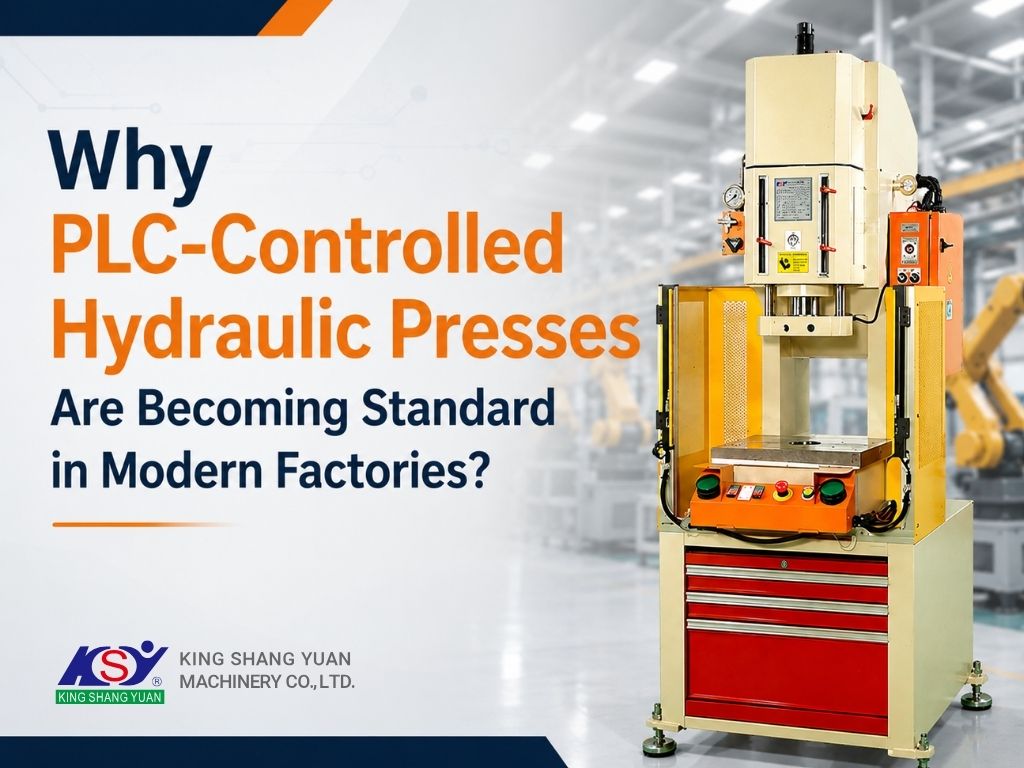
As manufacturing continues to evolve toward automation, data-driven production, and higher quality standards, equipment control systems have become just as important as mechanical performance. Today, manufacturers are no longer evaluating hydraulic presses based solely on tonnage or force capacity. Instead, they are increasingly focused on how well a machine can integrate into modern production environments.
As a result, PLC-controlled hydraulic presses are becoming increasingly common across industries ranging from automotive and electronics to hardware manufacturing and industrial assembly. Their ability to improve consistency, simplify operation, and support automation makes them a valuable investment for modern factories.
What Is a PLC-Controlled Hydraulic Press?
A PLC-controlled hydraulic press uses a Programmable Logic Controller (PLC) to manage machine functions such as pressure, stroke position, cycle timing, and safety logic.
Unlike conventional hydraulic presses that rely primarily on manual adjustments or simple electrical circuits, PLC-controlled systems allow operators to store, modify, and monitor production parameters through a centralized control platform.
Typical functions managed by a PLC include:
-
Pressing pressure
-
Stroke length
-
Cycle timing
-
Bottom dead center position
-
Automatic return functions
-
Safety interlocks
-
Communication with external equipment
This level of control enables more stable and repeatable manufacturing processes.
Why PLC-Controlled Hydraulic Presses Improve Production Consistency
PLC-controlled hydraulic presses improve production consistency by automatically maintaining predefined pressure, stroke, and cycle settings throughout production.
In traditional operations, product quality can vary depending on operator adjustments and machine setup. Even small differences in pressure or stroke position may affect finished part quality.
By storing and executing programmed parameters, PLC systems help ensure that every production cycle follows the same process.
Benefits include:
-
Consistent pressing force
-
Repeatable stroke positions
-
Stable cycle timing
-
Reduced product variation
-
Improved quality control
For manufacturers producing high volumes of parts, this consistency can significantly reduce scrap rates and rework.
How PLC Control Reduces Setup Time
PLC systems allow operators to save and recall production recipes, making product changeovers faster and more efficient.
Many factories produce multiple products using the same hydraulic press. Without PLC control, operators may need to manually adjust pressure settings, stroke positions, and timing parameters every time production changes.
With a PLC-controlled hydraulic press, these settings can be stored and recalled instantly.
This helps manufacturers achieve:
-
Faster setup times
-
Reduced operator error
-
Improved machine utilization
-
Shorter production interruptions
For facilities running multiple product types, reduced setup time directly contributes to higher productivity.
Why PLC-Controlled Hydraulic Presses Are Better for Automation
PLC-controlled hydraulic presses can communicate with robots, feeders, sensors, and conveyors, making them ideal for automated production environments.
Modern production lines often require multiple machines to work together as a coordinated system. PLC systems enable hydraulic presses to exchange signals with surrounding equipment and synchronize production processes.
Common integration examples include:
-
Robotic loading and unloading
-
Automatic feeding systems
-
Conveyor systems
-
Inspection stations
-
Production monitoring systems
This integration reduces manual handling and supports higher production efficiency.
How PLC Systems Improve Hydraulic Press Safety
PLC systems improve hydraulic press safety by continuously monitoring operating conditions and controlling safety functions.
Modern hydraulic presses often include multiple safety features that require coordinated control. PLC systems can manage these functions more effectively than traditional electrical circuits.
Examples include:
-
Dual-button operation logic
-
Emergency stop monitoring
-
Safety door interlocks
-
Automatic cycle interruption
-
Controlled return sequences
These functions help reduce the risk of accidents while maintaining efficient production flow.
How PLC Control Simplifies Monitoring and Maintenance
PLC-controlled hydraulic presses provide real-time machine information that helps manufacturers improve maintenance efficiency and reduce downtime.
Traditional hydraulic presses often provide limited diagnostic information when problems occur. PLC systems, however, can record and display operational data that assists maintenance personnel in identifying issues more quickly.
Typical monitoring functions include:
-
Cycle counts
-
Alarm history
-
Operating status
-
Production data
-
Fault diagnostics
Better visibility into machine performance helps manufacturers improve equipment reliability and reduce unexpected production interruptions.
Why PLC-Controlled Hydraulic Presses Support Industry 4.0
PLC-controlled hydraulic presses support Industry 4.0 initiatives by enabling data collection, equipment connectivity, and production monitoring.
As manufacturers adopt smart manufacturing strategies, production equipment must be capable of sharing information with factory management systems.
A PLC-controlled hydraulic press can provide data such as:
-
Machine utilization
-
Production output
-
Cycle times
-
Downtime events
-
Process consistency metrics
This information helps manufacturers make data-driven decisions and improve overall operational efficiency.
Signs It May Be Time to Upgrade to a PLC-Controlled Hydraulic Press
Manufacturers using older hydraulic press systems may encounter limitations that affect productivity and operational flexibility.
Common signs that an upgrade may be beneficial include:
-
Frequent manual adjustments
-
Long setup times
-
Inconsistent product quality
-
Difficulty troubleshooting machine issues
-
Limited automation compatibility
-
Increased operator dependency
If these challenges are becoming common, upgrading to a PLC-controlled hydraulic press may improve both efficiency and production consistency.
King Shang Yuan PLC-Controlled Hydraulic Press Solutions
At King Shang Yuan Machinery Co., Ltd., we understand the growing demand for hydraulic press systems that support modern manufacturing requirements.
Our hydraulic press solutions incorporate PLC automatic control systems that help manufacturers improve production consistency, simplify operation, and prepare for future automation initiatives.
Key features of our hydraulic press designs include:
-
PLC-based automatic control
-
Adjustable hydraulic pressure settings
-
Adjustable stroke and bottom dead center position
-
Dual-button safety operation systems
-
Energy-saving hydraulic design
-
Low-noise operation
-
Oil temperature cooling systems for continuous production
These features help manufacturers achieve stable and repeatable performance while maintaining operational safety and production efficiency.
Our hydraulic press solutions are suitable for standalone production, semi-automated workstations, and fully integrated manufacturing environments.
Learn more about our hydraulic press solutions:
https://www.ksy-machine.com/en-US/products
Conclusion
PLC-controlled hydraulic presses are becoming standard in modern factories because they offer far more than basic machine control. They improve production consistency, reduce setup time, enhance safety, simplify maintenance, and support automation integration.
As manufacturing continues to move toward smart production and Industry 4.0, PLC technology is increasingly viewed as a core requirement rather than an optional feature.
For manufacturers seeking greater efficiency, flexibility, and long-term operational reliability, a PLC-controlled hydraulic press can provide a significant competitive advantage.
FAQ
What is a PLC-controlled hydraulic press?
A PLC-controlled hydraulic press uses a programmable logic controller to manage pressure, stroke, timing, and safety functions, allowing more precise and repeatable operation.
Why are PLC-controlled hydraulic presses becoming more popular?
Manufacturers are adopting PLC-controlled hydraulic presses because they improve consistency, simplify operation, support automation, and enhance production efficiency.
Can PLC-controlled hydraulic presses be integrated into automated production lines?
Yes. PLC systems can communicate with robots, feeders, sensors, conveyors, and other equipment, making them suitable for automated manufacturing environments.
How does PLC control improve hydraulic press safety?
PLC systems can monitor safety conditions, manage emergency stops, control interlocks, and prevent unsafe machine operation.
Are PLC-controlled hydraulic presses suitable for small manufacturers?
Yes. Even smaller manufacturers can benefit from faster setup, reduced operator error, improved consistency, and easier production management.