

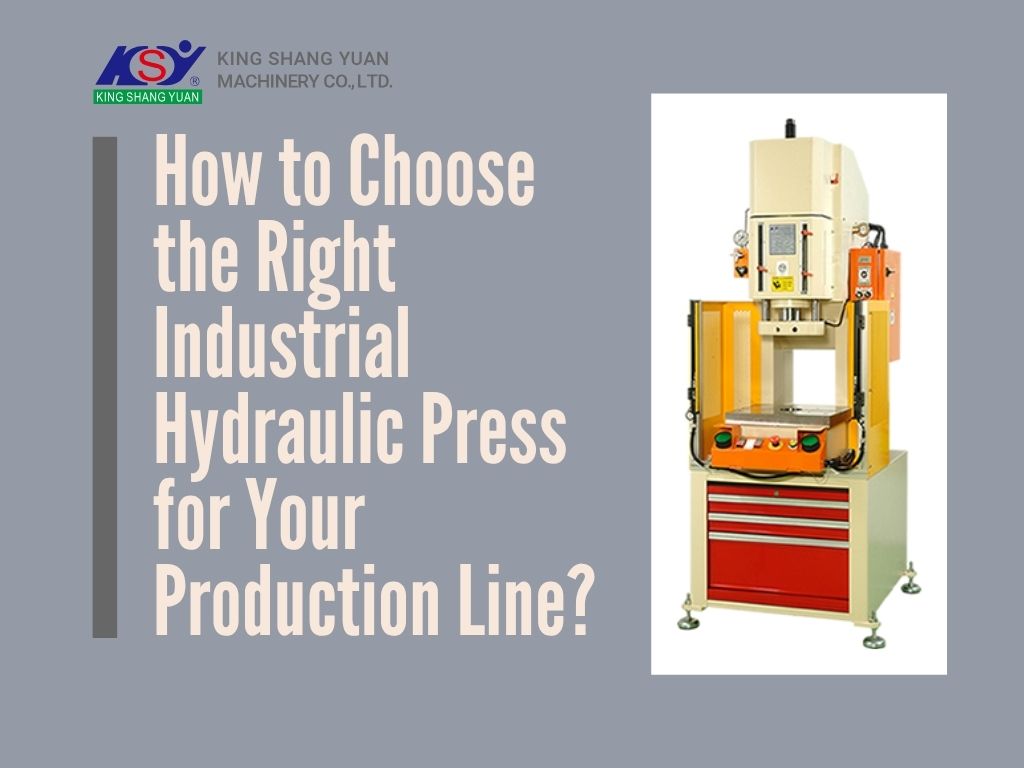
In modern manufacturing, selecting the right industrial equipment is critical for maintaining productivity, product quality, and long-term operational stability. Among the most widely used forming and assembly machines, the industrial hydraulic press plays a central role in punching, pressing, forming, and assembly operations across many industries.
However, choosing the right industrial hydraulic press is not simply about selecting the highest tonnage machine. A press that is too small may struggle with production demands, while an oversized system can increase equipment cost, energy consumption, and maintenance requirements unnecessarily.
For manufacturers planning new production lines or upgrading existing systems, understanding the key selection factors is essential. This article explains how to choose the right industrial hydraulic press for your production line and what considerations can help improve efficiency and production performance.
What Is an Industrial Hydraulic Press?
An industrial hydraulic press uses hydraulic power to generate controlled pressing force for manufacturing operations such as:
-
Punching
-
Forming
-
Press-fit assembly
-
Bending
-
Stamping
-
Riveting
-
Compression processing
Unlike mechanical presses, hydraulic systems provide smooth and adjustable force control, allowing manufacturers to regulate pressure, stroke length, and operating speed according to production requirements.
Because of this flexibility, industrial hydraulic presses are widely used in automotive, hardware, electronics, metal processing, and general manufacturing industries.
1. Determine the Required Press Tonnage
The first and most important factor is selecting the correct tonnage capacity.
The required force depends on:
-
Material type
-
Material thickness
-
Tooling design
-
Processing method
-
Workpiece size
For example:
-
Light assembly or small-part pressing may require lower tonnage
-
Metal forming and punching thicker materials require higher force capacity
Choosing insufficient tonnage can result in incomplete forming, unstable quality, or tooling damage. However, selecting excessive tonnage may increase energy consumption and operating costs unnecessarily.
Many manufacturers find that mid-range systems such as 50 ton hydraulic presses provide an effective balance between flexibility and production capability.
2. Understand Your Production Application
Different production applications require different hydraulic press characteristics.
For example:
Punching and Stamping
Require:
-
Stable pressing force
-
Consistent stroke control
-
Repeatable cycle performance
Press-Fit Assembly
Require:
-
Smooth motion
-
Accurate force control
-
Precise positioning
Forming and Bending
Require:
-
Adjustable pressure settings
-
Controlled forming speed
-
Stable bottom dead center positioning
Understanding the actual production process helps manufacturers avoid selecting machines optimized for the wrong application.
3. Consider Automation Compatibility
As manufacturing increasingly adopts automation, hydraulic press systems must be capable of integrating into modern production lines.
Important automation-related features include:
-
PLC-based control systems
-
Signal communication capability
-
Integration with robotic arms and feeders
-
Safety interlock systems
-
Adjustable production parameters
For manufacturers planning future expansion, automation compatibility is an important long-term investment consideration.
Hydraulic presses designed for automation integration can improve:
-
Production consistency
-
Labor efficiency
-
Production speed
-
Operational safety
4. Evaluate Stroke and Working Area Requirements
Tonnage alone does not determine whether a hydraulic press is suitable.
Manufacturers should also evaluate:
-
Stroke length
-
Open height
-
Working table size
-
Daylight area
-
Workpiece dimensions
A machine with insufficient stroke or table size may limit production capability even if the force capacity is sufficient.
When selecting an industrial hydraulic press, the physical dimensions of the tooling and workpiece should always be considered together with tonnage requirements.
5. Look for Stable Hydraulic Performance
Stable hydraulic performance directly affects production quality and machine reliability.
Important performance considerations include:
-
Smooth hydraulic motion
-
Stable pressure output
-
Low vibration
-
Consistent cycle repeatability
-
Temperature control capability
In continuous production environments, oil temperature stability becomes especially important. Excessive oil temperature can affect pressure consistency and reduce long-term operational reliability.
Hydraulic presses equipped with cooling systems can maintain stable performance during long operating hours.
6. Safety Features Are Essential
Industrial hydraulic presses must provide reliable safety protection for operators and surrounding equipment.
Key safety features may include:
-
Dual-button operation systems
-
Emergency stop systems
-
Safety guards and interlocks
-
Automatic return functions
-
PLC safety logic integration
For automated or semi-automated production lines, safety system integration becomes even more important.
Modern safety systems help reduce operator risk while maintaining efficient production flow.
7. Consider Energy Efficiency and Maintenance
Energy consumption and maintenance requirements affect long-term operating costs.
Modern industrial hydraulic presses often incorporate:
-
Energy-saving hydraulic systems
-
Low-noise operation
-
Simplified maintenance design
-
Efficient cooling systems
Machines designed for long-term operational stability can help reduce downtime and maintenance-related production interruptions.
King Shang Yuan Industrial Hydraulic Press Solutions
At King Shang Yuan Machinery Co., Ltd., we design industrial hydraulic press solutions that emphasize production efficiency, operational stability, and automation compatibility.
Our hydraulic press systems are developed to support a wide range of industrial applications, including punching, forming, assembly, and press-fit operations.
Key design features include:
-
Adjustable pressure, stroke, and bottom dead center settings
-
PLC automatic control systems
-
Dual-button safety operation logic
-
Energy-saving and low-noise hydraulic systems
-
Oil temperature cooling systems for continuous operation
-
Stable hydraulic output for production consistency
These features help manufacturers improve operational efficiency while maintaining safe and reliable production performance.
Our hydraulic press solutions can be used as standalone systems or integrated into semi-automated and automated production lines.
Learn more about our hydraulic press solutions:
https://www.ksy-machine.com/en-US/products
Conclusion
Choosing the right industrial hydraulic press requires more than simply comparing tonnage specifications. Manufacturers must evaluate production applications, automation requirements, stroke capacity, safety systems, and long-term operational stability.
A properly selected hydraulic press can improve production efficiency, maintain product consistency, and support future manufacturing expansion.
For manufacturers planning new production lines or upgrading existing equipment, understanding these selection factors can help ensure the hydraulic press system matches actual production requirements.
If your production requires flexible, stable, and automation-ready hydraulic press solutions, selecting the right industrial hydraulic press can provide long-term manufacturing advantages.
FAQ
What is the most important factor when choosing an industrial hydraulic press?
The most important factor is matching the press capacity and specifications to the actual production application, including material type, force requirements, and production method.
How do I know what hydraulic press tonnage I need?
Required tonnage depends on material thickness, tooling design, and processing type. Manufacturers often calculate tonnage requirements based on forming force and safety margins.
Can industrial hydraulic presses be integrated into automated production lines?
Yes. Many modern industrial hydraulic presses support PLC control and integration with robotic arms, feeders, and automated production systems.
Why is oil temperature control important in hydraulic presses?
Stable oil temperature helps maintain consistent hydraulic pressure and reduces performance fluctuations during long continuous production cycles.