

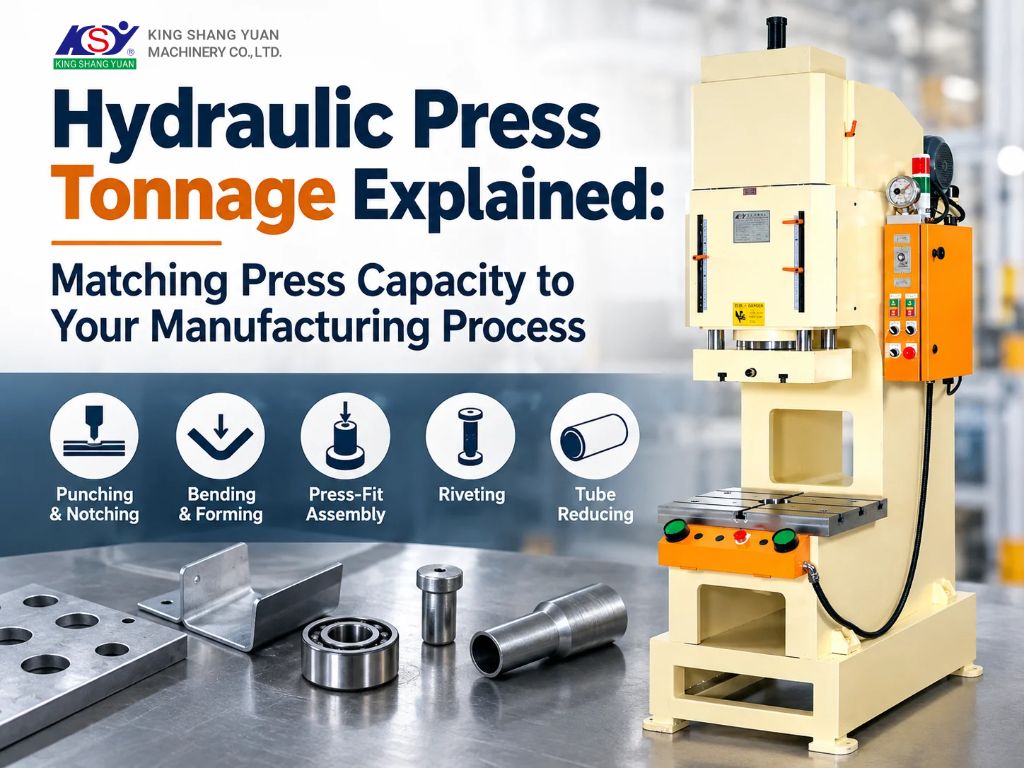
Selecting the correct hydraulic press tonnage is essential for achieving consistent production results, protecting tooling, and avoiding unnecessary equipment costs. However, a press with a higher tonnage rating is not automatically the best choice. Different manufacturing processes require different levels of force, stroke, working space, and control.
Punching sheet metal, forming components, installing bearings, riveting fasteners, and reducing tube diameters all involve applying force. However, the amount of force required—and how it must be applied—varies significantly between these operations.
At King Shang Yuan Machinery Co., Ltd., we provide hydraulic press solutions for different industrial applications. Understanding how press capacity relates to actual manufacturing requirements helps manufacturers select equipment that supports their production processes without relying on tonnage alone.
This guide explains hydraulic press tonnage, compares force requirements across manufacturing processes, and identifies the specifications manufacturers should evaluate before selecting a machine.
1. What Does Hydraulic Press Tonnage Mean?
Hydraulic press tonnage refers to the maximum rated pressing force a machine can generate under specified operating conditions. It is commonly expressed in tons or tonnes, although the exact force unit should be confirmed with the equipment manufacturer.
A 50-ton hydraulic press provides greater rated force capacity than a 10-ton press, but this does not mean every operation performed on the larger machine requires its full capacity.
Hydraulic pressing force is fundamentally related to hydraulic pressure and the effective area of the cylinder piston:
Pressing Force = Hydraulic Pressure × Effective Piston Area
This equation describes the theoretical force generated by a hydraulic cylinder. Actual available force at the tooling may differ because of system losses, cylinder configuration, and operating conditions.
The distinction between rated press capacity and required process force is important. Rated capacity indicates what the machine can deliver under specified conditions, while process force represents what the manufacturing operation actually needs.
Manufacturers should calculate or estimate the required process force before determining the appropriate hydraulic press capacity.
2. Why Do Different Manufacturing Processes Require Different Press Capacities?
Different manufacturing processes require different press capacities because material resistance, workpiece geometry, tooling, and the type of deformation all influence the force required.
For example, punching requires sufficient force to shear material, while bending requires force to deform it. Press-fit assembly involves overcoming interference and friction between components, often with greater emphasis on controlling the final insertion position.
The following table summarizes the main differences.
| Manufacturing Process | Primary Force Requirement | Important Selection Factors |
|---|---|---|
| Punching | Shearing material along a cutting perimeter | Material thickness, shear strength, punch geometry |
| Notching | Removing material along a defined cutting profile | Cutting length, material properties, tooling |
| Bending and forming | Permanently deforming material | Material strength, thickness, forming geometry |
| Press-fit assembly | Overcoming interference and friction | Fit tolerance, insertion depth, alignment |
| Riveting | Deforming a fastening element | Rivet dimensions, material, joint requirements |
| Tube reducing | Reducing tube diameter or cross-section | Tube dimensions, material, reduction ratio |
Key takeaway: Hydraulic press tonnage should be determined by the force requirements of the intended manufacturing process, not by machine size or capacity alone.
3. How Much Hydraulic Press Tonnage Is Required for Punching and Notching?
Punching and notching require enough force to shear material along a defined cutting perimeter. The required force generally increases with material thickness, shear strength, and total cutting length.
A simplified punching-force calculation is:
F = L × t × τ
Where:
- F: Estimated punching force (N)
- L: Cutting perimeter (mm)
- t: Material thickness (mm)
- τ: Material shear strength (N/mm²)
Example: Calculating Punching Force
Consider punching a circular hole under the following conditions:
| Parameter | Value |
|---|---|
| Hole diameter | 20 mm |
| Material thickness | 3 mm |
| Assumed shear strength | 300 N/mm² |
First, calculate the cutting perimeter:
L = π × 20 = 62.83 mm
Then calculate the estimated punching force:
F = 62.83 × 3 × 300 = 56,547 N
The result is approximately 56.5 kN, equivalent to 5.8 metric tonnes-force.
For a 20 mm diameter hole in 3 mm thick material with an assumed shear strength of 300 N/mm², the estimated punching force is approximately 5.8 metric tonnes-force. This represents a theoretical cutting-force estimate, not the final recommended hydraulic press capacity.
Actual machine selection must also consider tooling geometry, stripping force, operating conditions, and an appropriate capacity allowance.
For notching applications, manufacturers should additionally evaluate workpiece positioning, feeding arrangements, and repeated operation requirements.
A hydraulic press with sufficient tonnage may still be unsuitable if its tooling space or production configuration does not match the process.
4. What Determines Press Capacity for Bending and Forming?
Hydraulic press capacity for bending and forming depends on material strength, thickness, forming length, die geometry, and the specific forming method.
Unlike punching, forming force cannot be estimated from cutting perimeter alone because the material is being permanently deformed rather than separated.
For sheet-metal bending, force requirements vary between air bending, bottoming, and coining. The same workpiece may require substantially different forces depending on the selected method and tooling.
Other forming operations, such as deep drawing, introduce additional considerations, including material flow, friction, blank holding, and changes in force throughout the stroke.
Why Stroke and Tooling Space Matter
A press may provide sufficient maximum force but still be unsuitable for the operation if the working height or stroke is inadequate.
For example, a forming die may require additional vertical clearance for workpiece loading, material deformation, and finished-part removal.
Manufacturers should therefore evaluate the required forming force together with the complete tooling arrangement.
Key takeaway: Bending and forming applications require a hydraulic press that provides sufficient force at the required working position, along with adequate stroke and tooling space.
5. Why Is Force Control Important in Press-Fit Assembly?
Force control is important in press-fit assembly because components must be inserted with sufficient force to achieve the required fit without excessive loading or unintended deformation.
Typical applications include bearing installation, bushing insertion, shaft fitting, pin installation, and mechanical component joining.
The force required for these operations depends on interference between mating parts, component dimensions, material properties, surface conditions, and tooling design.
Insufficient force may prevent a component from reaching its specified position. Excessive force or uncontrolled travel may damage the component or surrounding structure.
Force and Position Must Be Considered Together
In assembly applications, the final pressing position can be just as important as the force applied.
A hydraulic press with adjustable pressure and press position can help manufacturers establish suitable operating conditions for different workpieces.
However, consistent assembly quality also depends on tooling alignment, dimensional tolerances, and proper process validation.
A larger press does not automatically produce better assembly results.
For a more detailed discussion, read Hydraulic Press for Assembly Applications: Why Controlled Force Matters.
6. How Does Riveting Force Affect Hydraulic Press Selection?
Riveting force affects hydraulic press selection because the machine must provide sufficient force to deform the fastening element and produce the required joint without damaging the assembled components.
The required force depends on rivet diameter, material strength, rivet geometry, and the intended deformation.
A larger or stronger rivet generally requires greater forming force, but the relationship also depends on the riveting method and tooling design.
For example, solid riveting and tubular riveting may have different force requirements even when used on similar assemblies.
What Else Should Manufacturers Evaluate?
In addition to rated tonnage, riveting applications require attention to pressing travel, tool alignment, and final joint dimensions.
Insufficient force may result in an incomplete joint. Excessive force can deform the surrounding workpiece or produce an unsuitable rivet shape.
Manufacturers should establish the required joint specifications and validate the riveting process before selecting machine capacity.
Key takeaway: Hydraulic press selection for riveting should be based on the force and deformation required to produce an acceptable joint, rather than rivet dimensions alone.
7. What Determines Hydraulic Press Capacity for Tube Reducing?
Hydraulic press capacity for tube reducing depends on tube material, initial diameter, wall thickness, reduction ratio, die geometry, and friction during deformation.
Tube reducing involves decreasing a tube's diameter or cross-sectional dimensions through controlled deformation.
As the tube passes through or is pressed into the reducing tooling, the material must deform while maintaining the required finished dimensions.
The required force can change throughout the operation depending on the amount of reduction, material behavior, and tooling conditions.
Why Machine Configuration Matters
Tube reducing may require a dedicated tooling arrangement and sufficient stroke to complete the deformation process.
The machine must also provide suitable working space for loading, positioning, and removing the tube.
For specialized tube processing, a standard hydraulic press may not provide the most practical production arrangement even if its maximum force capacity is sufficient.
In these situations, a Special Purpose Machine may be considered to accommodate the required tooling and production sequence.
Key takeaway: Tube reducing requires evaluation of both deformation force and machine configuration, including tooling, stroke, and workpiece handling.
8. What Specifications Matter Besides Hydraulic Press Tonnage?
Besides rated tonnage, manufacturers should evaluate stroke length, working height, table dimensions, pressure adjustment, positioning, control functions, and tooling compatibility.
These specifications determine whether the machine can perform the intended operation under practical production conditions.
| Machine Specification | Why It Matters |
|---|---|
| Rated Pressing Force | Determines maximum available force under rated conditions |
| Stroke Length | Determines the distance the press head can travel |
| Working Height | Determines available vertical space for tooling and workpieces |
| Working Table Size | Determines whether fixtures and components can fit |
| Pressure Adjustment | Allows pressing conditions to be matched to process requirements |
| Press Position Adjustment | Helps establish the intended final pressing position |
| Control System | Influences operating sequence and consistency |
| Tooling Compatibility | Determines whether the required operation can be performed |
| Production Configuration | Affects loading, unloading, and process integration |
Why Maximum Tonnage Alone Is Not Enough
For example, a manufacturer may estimate that a process requires 18 metric tonnes-force. However, if the tooling cannot fit within the machine's available working height, a press with adequate rated force is still unsuitable.
Likewise, a process involving several repeated operations may benefit from a multi-station configuration rather than a machine with greater tonnage.
The appropriate hydraulic press must satisfy the force requirement while accommodating the complete manufacturing process.
9. How Can Manufacturers Match Press Capacity to Production Requirements?
Manufacturers can match hydraulic press capacity to production requirements by identifying the process, estimating maximum force, confirming tooling dimensions, and verifying machine specifications under actual operating conditions.
The following evaluation sequence helps organize the selection process.
Step 1: Identify the Manufacturing Operation
Determine whether the press will perform punching, forming, assembly, riveting, tube reducing, or another operation.
If the machine will support multiple processes, each operation should be evaluated separately.
Step 2: Confirm Workpiece and Tooling Specifications
Collect the material grade, thickness, dimensions, finished-part requirements, and tooling information.
For assembly applications, include fit tolerances and required insertion depth. For forming operations, include die geometry and required stroke.
Step 3: Estimate the Required Process Force
Use an appropriate engineering calculation, tooling supplier information, or validated production data.
The calculation method should reflect the actual operation. A punching-force formula should not be used to estimate the force required for press-fit assembly or tube reducing.
Step 4: Evaluate Capacity Allowance and Operating Conditions
Consider variation in material properties, tooling requirements, process uncertainty, and the manufacturer's rated operating conditions.
There is no universal capacity margin suitable for every hydraulic pressing application.
The selected press should provide sufficient force without relying on operation beyond its rated capacity.
Step 5: Verify Machine and Production Compatibility
Confirm that the available stroke, working height, table dimensions, controls, and tooling arrangement meet production requirements.
For repetitive or multi-stage operations, evaluate whether a standard press, rotatory-type press, or special purpose machine is the most suitable configuration.
Selection principle: Calculate the required process force first, then confirm the complete machine configuration. Do not select equipment solely because its rated tonnage exceeds the calculated force.
10. King Shang Yuan Hydraulic Press Solutions
King Shang Yuan Machinery Co., Ltd. provides hydraulic press solutions for general industrial processing and applications requiring specialized equipment configurations.
Our Hydraulic Press product range includes machines with rated capacities from 1.5 to 50 tons. Available machine features include hydraulic pressure adjustment, punch head positioning, bottom dead center position adjustment, and PLC control, depending on the model.
For production involving multiple workstations, our Rotatory-Type Hydraulic Press solutions offer indexing configurations for repeated processing operations, with options for feeding, unloading, and inspection integration.
We also provide Hydraulic Press for Lock Nut Notches and Assembly and Special Purpose Machines for applications requiring specific tooling or production arrangements.
When evaluating a hydraulic press, we encourage customers to provide workpiece drawings, material specifications, expected pressing force, tooling dimensions, and production requirements.
These details help identify the appropriate press capacity and equipment configuration for the intended manufacturing process.
11. Conclusion: Match Hydraulic Press Tonnage to the Actual Process
Hydraulic press tonnage should be selected according to the force required by the manufacturing process—not simply by choosing the largest available machine.
Punching, forming, assembly, riveting, and tube reducing each involve different force requirements. Even when the required force is known, machine stroke, working height, tooling, positioning, and control functions must also be evaluated.
A properly matched hydraulic press provides sufficient capacity while supporting the operating conditions needed for consistent production.
Need Help Evaluating Hydraulic Press Capacity?
Contact King Shang Yuan Machinery Co., Ltd. with your workpiece specifications, drawings, and production requirements. Our team can discuss suitable hydraulic press solutions for your manufacturing process.
12. Frequently Asked Questions
Q1. How do I calculate the tonnage required for a hydraulic press?
The calculation depends on the manufacturing process. Punching force can be estimated using cutting perimeter, material thickness, and shear strength. Forming, riveting, and press-fit assembly require different calculations based on geometry, material properties, and tooling conditions.
The calculated process force should be evaluated alongside machine ratings and operating requirements before selecting capacity.
Q2. Is a 50-ton hydraulic press suitable for every application requiring less than 50 tons?
No. A 50-ton rating indicates the machine's maximum rated pressing force under specified conditions.
Suitability also depends on available force at the required working position, stroke, working height, tooling arrangement, and control functions. A machine with adequate tonnage may still be unsuitable for a particular operation.
Q3. Can a hydraulic press with adjustable pressure handle different materials?
Potentially, yes. Adjustable hydraulic pressure allows manufacturers to establish different pressing conditions for workpieces with varying force requirements.
However, the machine must still have sufficient rated capacity, suitable tooling, adequate working space, and appropriate controls for each material and process.
Pressure adjustment alone does not guarantee compatibility with every application.
Q4. What information should I provide when requesting a hydraulic press quotation?
Manufacturers should provide the intended process, workpiece drawings, material specifications, dimensions, required force if known, tooling information, and production volume.
Additional details such as stroke requirements, working height, loading method, and control expectations help equipment suppliers evaluate the appropriate machine configuration.
Providing complete application information can reduce uncertainty during hydraulic press selection.