

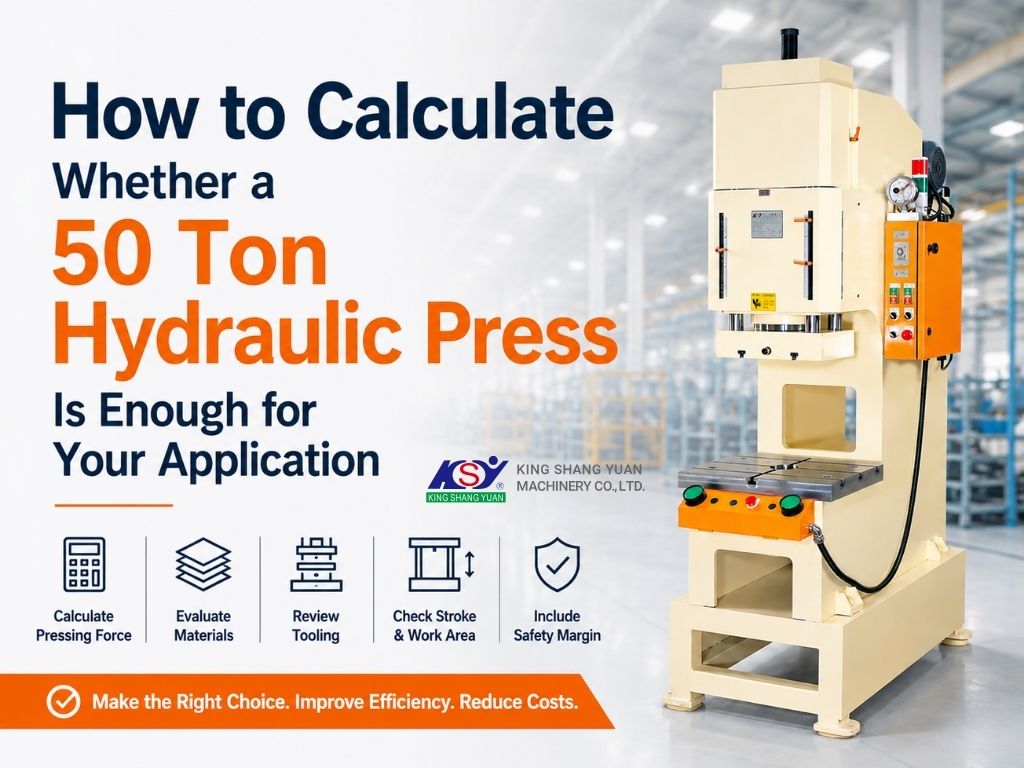
Selecting the right hydraulic press is one of the most important decisions in any manufacturing process. While many buyers focus on maximum tonnage, choosing a hydraulic press based solely on force capacity can result in unnecessary investment or insufficient production performance.
One of the most common questions manufacturers ask is:
Is a 50 ton hydraulic press enough for my application?
The answer depends on much more than tonnage alone. Material properties, tooling design, workpiece dimensions, and production requirements all influence the actual force required.
This article explains the key factors manufacturers should evaluate to determine whether a 50 ton hydraulic press is the right solution for their production needs.
Step 1: Define Your Manufacturing Process
The first step is identifying exactly what the hydraulic press will be used for. Different manufacturing processes require different levels of pressing force.
Typical applications include:
- Metal punching
- Press-fit assembly
- Metal forming
- Bending
- Riveting
- Compression
- Tube enlarging or reducing
For example, press-fit assembly generally requires less force than forming thick steel components. Clearly defining the application provides the foundation for selecting the correct hydraulic press.
Step 2: Evaluate Material Type and Thickness
Material characteristics have a direct impact on the required tonnage. Harder, stronger, or thicker materials generally require more pressing force.
Key considerations include:
- Material type
- Material thickness
- Material hardness
- Yield strength
- Shear strength
For example, punching stainless steel generally requires more force than punching aluminum of the same thickness. Likewise, increasing material thickness can significantly increase the force needed to complete a punching or forming operation.
Understanding the material is therefore one of the most important steps in determining whether a 50 ton hydraulic press is sufficient.
Step 3: Review the Tooling Design
The required pressing force is also influenced by the design of the punch, die, fixture, and other tooling components.
Important tooling factors include:
- Punch diameter or cutting perimeter
- Die clearance
- Contact area
- Tool geometry
- Number of features processed in one cycle
A larger contact or cutting area usually requires more force. Even when processing the same material, different tooling designs can produce significantly different tonnage requirements.
Manufacturers should therefore evaluate the complete tooling system rather than calculating the requirement from material properties alone.
Step 4: Check the Stroke and Working Area
Many buyers compare only tonnage while overlooking the machine's physical working capacity. However, sufficient force does not automatically mean that the press can accommodate the workpiece and tooling.
Specifications that should be checked include:
- Stroke length
- Open height
- Working table size
- Available daylight
- Die and fixture dimensions
- Workpiece loading and unloading clearance
A hydraulic press may provide sufficient force but still be unsuitable if the tooling exceeds the available table area or if the stroke is too short to complete the operation.
Selecting the correct working envelope helps ensure smoother production and provides flexibility for future tooling changes.
Step 5: Include an Appropriate Safety Margin
Production conditions are rarely identical throughout the entire life of a project. Material variation, tooling wear, alignment changes, and future product designs may all affect the actual force requirement.
Instead of selecting a hydraulic press that must continuously operate at its maximum capacity, manufacturers should include an appropriate safety margin.
This helps improve:
- Production stability
- Tool life
- Machine reliability
- Process consistency
- Long-term production flexibility
The safety margin should be based on the application and engineering assessment rather than an arbitrary percentage. Excessive oversizing may increase costs, while insufficient reserve capacity may affect process reliability.
50 Ton Hydraulic Press Evaluation Flow
The following decision flow summarizes the main factors that should be evaluated before selecting a 50 ton hydraulic press.
| 1. Define the Manufacturing Process Punching, forming, bending, riveting, press-fit assembly, or tube processing |
| ↓ |
| 2. Evaluate Material Type and Thickness Review material strength, hardness, thickness, and processing resistance |
| ↓ |
| 3. Review the Tooling Design Check punch size, die clearance, contact area, and tool geometry |
| ↓ |
| 4. Check the Stroke and Working Area Confirm that the stroke, open height, table size, and daylight are sufficient |
| ↓ |
| 5. Include an Appropriate Safety Margin Allow for normal material variation, tooling wear, and future production changes |
| ↓ |
| Is a 50 Ton Hydraulic Press Suitable? |
| ↓ |
| YES: A 50 ton hydraulic press may be suitable for the application. |
| NO: Consider a higher-capacity press or a different machine configuration. |
This flow provides an initial evaluation only. The final machine selection should be confirmed through an engineering review of the workpiece, material, tooling, and required production cycle.
Quick Evaluation Checklist
Before selecting a 50 ton hydraulic press, ask the following questions:
- Is the calculated pressing force within the machine's rated capacity?
- Have the material type, thickness, hardness, and strength been evaluated?
- Does the tooling design increase the required force?
- Are the stroke, open height, table size, and daylight sufficient?
- Has an appropriate safety margin been included?
- Can the machine accommodate future product or tooling changes?
- Does the required production speed match the hydraulic press cycle?
If these conditions are satisfied, a 50 ton hydraulic press may provide an effective balance of capacity, flexibility, and operating cost for a medium-duty manufacturing application.
Typical Applications for a 50 Ton Hydraulic Press
A 50 ton hydraulic press is commonly used in manufacturing processes that require medium pressing force and flexible parameter control.
Typical applications include:
- Metal punching and stamping
- Press-fit assembly
- Bearing and bushing insertion
- Fastener and component assembly
- Riveting
- Small to medium metal forming
- Tube enlarging and reducing
- Hardware manufacturing
- Automotive component production
Its balanced combination of force capacity and operational flexibility makes the 50 ton range suitable for many general industrial applications. However, suitability must still be confirmed based on the actual material, tooling, and production conditions.
When a 50 Ton Hydraulic Press May Not Be Enough
A 50 ton hydraulic press may not be suitable when the required operation involves exceptionally high material resistance, a large contact area, heavy-duty forming, or oversized tooling.
Applications that may require a higher-capacity or specialized press include:
- Deep drawing of large components
- Heavy forming of thick, high-strength steel
- Large structural workpieces
- Multi-point punching with a large total cutting perimeter
- Operations requiring more than 50 tons after including the safety margin
- Tooling or workpieces that exceed the available working area
When the calculated requirement approaches the press's maximum rated force, manufacturers should avoid making assumptions and request a detailed engineering evaluation.
King Shang Yuan KSY-500H 50 Ton Hydraulic Press
At King Shang Yuan Machinery Co., Ltd., we understand that selecting the correct hydraulic press requires more than comparing maximum tonnage specifications.
Our KSY-500H 50 Ton Hydraulic Press is designed to deliver stable hydraulic performance for a wide range of industrial punching, forming, processing, and assembly applications.
Key features include:
- PLC automatic control
- Adjustable hydraulic pressure
- Easy adjustment of the punch head position
- Adjustable bottom dead center position
- Dual-button safety operation
- Punch head return when the operator releases the buttons
- Energy-saving and low-noise hydraulic operation
- Oil-temperature cooling for stable continuous operation
These features help manufacturers maintain consistent processing conditions while improving operational flexibility, productivity, and safety.
Rather than simply recommending the highest tonnage available, we work with customers to evaluate their materials, tooling, workpieces, and production requirements before recommending a suitable hydraulic press configuration.
Learn more about the KSY-500H 50 Ton Hydraulic Press .
Conclusion
Determining whether a 50 ton hydraulic press is sufficient requires more than checking the machine's maximum force rating.
Manufacturers should evaluate the production process, material characteristics, tooling design, required stroke, working area, production speed, and an appropriate safety margin. Considering these factors together helps avoid both insufficient capacity and unnecessary equipment oversizing.
A properly selected hydraulic press can improve production efficiency, product quality, tooling reliability, and long-term operational stability.
If you are unsure whether a 50 ton hydraulic press is suitable for your application, contact King Shang Yuan Machinery Co., Ltd. Our team can review your production requirements and help recommend an appropriate hydraulic press solution.
FAQ: Choosing a 50 Ton Hydraulic Press
How do I calculate whether a 50 ton hydraulic press is enough?
Evaluate the required force for the manufacturing process based on the material type, material thickness, tooling design, and contact or cutting area. Then confirm that the press also provides sufficient stroke, table size, open height, and reserve capacity for the application.
Is a larger hydraulic press always a better choice?
No. An oversized hydraulic press may increase equipment cost, energy consumption, installation space, and maintenance requirements without improving production results. The press should be matched to the actual process rather than selected only by maximum tonnage.
Should a 50 ton press operate continuously at its maximum force?
It is generally better to include an appropriate safety margin instead of designing a process that requires the machine to operate continuously at its maximum rated capacity. The required margin should be determined according to the application and engineering conditions.
What industries commonly use 50 ton hydraulic presses?
A 50 ton hydraulic press is commonly used in hardware manufacturing, automotive component production, electronics, metal processing, press-fit assembly, tube processing, and general industrial manufacturing.
Can a 50 ton hydraulic press be integrated into an automated production line?
Yes. A PLC-controlled 50 ton hydraulic press can be integrated with feeders, robots, sensors, and other production equipment when its controls and safety interlocks are properly configured for the automated system.
What information should I provide when requesting a hydraulic press recommendation?
Provide the material type, material thickness, workpiece dimensions, tooling drawings, required operation, target cycle time, production volume, and automation requirements. This information allows the manufacturer to evaluate the required tonnage and machine configuration more accurately.