

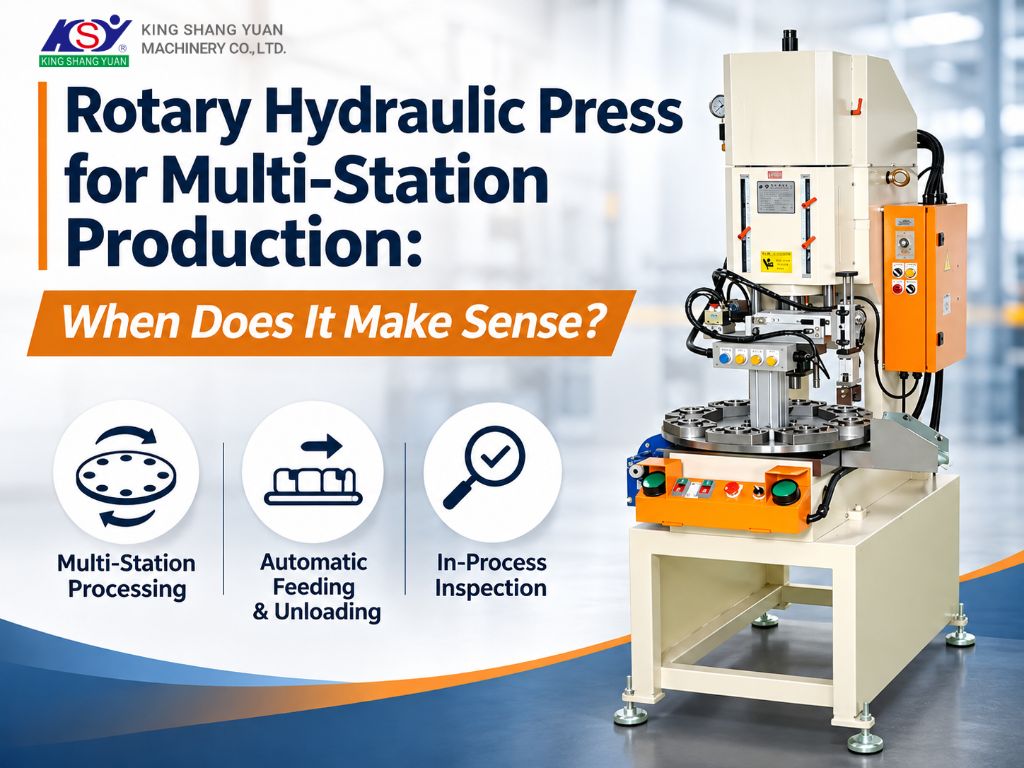
A rotary hydraulic press is worth considering when manufacturers need to handle repetitive punching operations across multiple workstations, reduce manual workpiece handling, or integrate loading, processing, and unloading into a more organized production sequence.
Unlike a conventional single-station hydraulic press, a rotary hydraulic press uses an indexing mechanism to move workpieces between designated positions. This allows manufacturers to plan different operations around a rotating carrier rather than repeatedly loading and removing parts at one fixed working position.
However, a rotary system is not automatically more efficient for every application. Its suitability depends on production volume, process sequence, tooling arrangement, workpiece characteristics, and the time required for each operation.
King Shang Yuan Machinery Co., Ltd. offers Rotatory-Type Hydraulic Press solutions designed for multi-station production. This article explains when a rotary configuration makes sense, how to evaluate its potential benefits, and what manufacturers should confirm before selecting one.
1. What Is a Rotary Hydraulic Press?
A rotary hydraulic press is a hydraulic pressing machine equipped with a rotating or indexing mechanism that moves workpieces between designated positions. It is commonly used when a production process benefits from repeated positioning, multiple stations, or coordinated material handling.
In a conventional single-station hydraulic press, operators or automated equipment typically load the workpiece, complete the pressing operation, and remove the finished part at the same working position.
A rotary configuration separates these activities across different positions on a rotating carrier.
For example, one position may be used for workpiece loading, another for punching, and another for unloading. Depending on the machine design, additional positions may support other processing or inspection requirements.
The primary advantage is not greater pressing force. Instead, the rotary arrangement changes how workpieces move through the production process.
2. How Does a Rotary Hydraulic Press Support Multi-Station Production?
A rotary hydraulic press supports multi-station production by using an indexing mechanism to move workpieces from one designated position to another in a controlled sequence.
Each indexing movement positions the workpiece for the next scheduled operation. The number and function of stations depend on the process requirements and machine configuration.
Example: A Four-Position Production Arrangement
The following example illustrates how a rotary production sequence could be organized. It is a conceptual layout rather than a fixed configuration supplied with every machine.
| Position | Operation | Purpose |
|---|---|---|
| Station 1 | Workpiece loading | Place the component into its fixture |
| Station 2 | Hydraulic punching | Perform the required pressing operation |
| Station 3 | Inspection | Check a specified feature or processing result |
| Station 4 | Unloading | Remove the processed component |
After each indexing movement, workpieces advance to their next designated positions.
Where the machine and tooling are designed for compatible simultaneous station activities, loading or unloading may take place while another workpiece is being processed.
However, the actual production sequence depends on machine controls, station timing, safety requirements, and whether the operations can be performed concurrently.
Why Indexing Accuracy Matters
Accurate indexing helps position workpieces consistently relative to the processing tools.
Poor positioning can cause misalignment between the workpiece and tooling, potentially affecting processing quality or increasing tooling wear.
For this reason, the indexing mechanism, fixture design, and support structure must be considered together.
3. When Should Manufacturers Consider a Rotary Hydraulic Press?
Manufacturers should consider a rotary hydraulic press when repeated loading, positioning, punching, and unloading activities create production bottlenecks that could be reduced through a multi-station arrangement.
When Repeated Manual Handling Limits Production
In a single-station process, operators may need to load a part, initiate pressing, wait for the cycle to finish, and remove the part before beginning the next cycle.
If workpiece handling takes a significant portion of the total cycle time, separating loading and unloading from the pressing position may improve workflow.
A rotary configuration can support this arrangement, provided the machine is designed to coordinate the activities safely.
When Workpieces Require Repeated Positioning
Some components require consistent placement before punching or another pressing operation.
A rotary indexing system combined with suitable fixtures can help establish repeatable positioning between stations.
However, indexing accuracy alone does not guarantee finished-part accuracy. Tooling, workpiece tolerances, and fixture design remain important.
When Production Includes Multiple Operations
A rotary hydraulic press may be suitable when a production sequence involves several compatible activities, such as loading, punching, inspection, and unloading.
Instead of treating these as separate manual steps, manufacturers can evaluate whether they can be arranged within one coordinated machine.
When Production Volume Justifies a Dedicated Setup
Rotary systems generally require more detailed station planning and tooling arrangements than a basic single-station press.
For frequently changing, low-volume jobs, this additional setup may not be justified.
For stable, repetitive production, however, the potential reduction in handling time and improvement in workflow consistency may make the investment worthwhile.
4. Single-Station vs. Rotary Hydraulic Press: Which Is More Suitable?
A single-station hydraulic press is generally more suitable for straightforward pressing operations, frequent product changes, or lower production volumes. A rotary hydraulic press becomes more attractive when repeated workpiece handling and coordinated station activities are important to production efficiency.
| Selection Factor | Single-Station Hydraulic Press | Rotary Hydraulic Press |
|---|---|---|
| Production type | Individual or varied pressing jobs | Repetitive, multi-station workflows |
| Workpiece handling | Loading and unloading at one position | Activities can be assigned to different positions |
| Tooling arrangement | Usually simpler | Requires station and indexing coordination |
| Product changeovers | Often easier for simple tooling | May require additional fixture and station adjustments |
| Automation integration | Possible with suitable equipment | Can support coordinated feeding, processing, and unloading |
| Initial system complexity | Generally lower | Generally higher |
| Best fit | Flexible, straightforward operations | Stable production with repeatable sequences |
Practical Selection Scenarios
Scenario A: Small Batches with Frequent Tooling Changes
A manufacturer produces several different parts each day, with relatively short production runs and one pressing operation per part.
Suggested direction: A single-station hydraulic press is likely the more practical starting point because flexibility and simpler changeovers are important.
Scenario B: High-Volume Repetitive Punching
A manufacturer repeatedly processes the same component, with manual loading and unloading contributing significantly to cycle time.
Suggested direction: A rotary hydraulic press is worth evaluating, especially if workpiece handling can be organized across separate positions.
Scenario C: Punching Followed by Inspection
A manufacturer needs to perform a repeated punching operation and verify selected part characteristics before unloading.
Suggested direction: A rotary system with appropriately configured inspection sensors may help integrate these activities into a coordinated workflow.
These examples illustrate possible selection directions, not guaranteed productivity improvements. The final decision should be based on actual cycle times, production requirements, and machine configuration.
5. How Many Workstations Does a Rotary Hydraulic Press Need?
The appropriate number of workstations depends on the operations required, the indexing sequence, and the space needed for tooling and workpiece handling.
A rotary hydraulic press should not be selected simply by choosing the largest available number of stations.
Manufacturers should first identify which activities need separate positions and which can be performed together.
For example, a process involving loading, punching, and unloading may require a different station arrangement from one that also includes inspection or additional processing stages.
What Determines the Station Count?
Station planning should consider the complete sequence, including loading, pressing, inspection, unloading, and any required empty or clearance positions.
Tooling dimensions and workpiece size can also limit how many practical stations can fit around the rotary carrier.
The longest station operation is especially important. In an indexed system, one slow activity may determine the overall cycle time, even when other stations finish more quickly.
King Shang Yuan's Rotatory-Type Hydraulic Press series uses a high-precision indexing system with selectable 4–16 divisions, allowing station arrangements to be planned according to production requirements.
The number of divisions should therefore be determined through process planning rather than treated as a direct measure of productivity.
6. How Can Automatic Feeding and Unloading Improve Production?
Automatic feeding and unloading can improve rotary hydraulic press production by reducing repeated manual handling and helping maintain a more consistent flow of workpieces through the machine.
However, automation should be evaluated according to the actual bottleneck.
If pressing time is much longer than loading time, automatic feeding may have limited impact on total output. If handling time is the main constraint, automation may provide a more meaningful benefit.
Feeding and Unloading
An automatic feeding system can transfer workpieces into the designated loading position when their shape, orientation, and handling requirements are compatible with the system.
Automatic unloading can remove processed parts without requiring an operator to perform the same repetitive removal task each cycle.
Both functions require appropriate mechanical design, controls, and safety integration.
Material Detection and Inspection
Sensors may be used to check whether a workpiece is present at the correct position before processing.
Additional inspection sensors can be configured to detect selected characteristics of processed parts or support good/defective product handling.
These systems do not replace all quality inspection activities. Their effectiveness depends on what the sensors are designed and validated to detect.
King Shang Yuan offers optional automatic feeding, automatic unloading, material detection, and post-punching inspection sensor configurations for its rotary hydraulic press solutions.
Does Automation Always Increase Output?
Not necessarily. Actual output depends on the complete production cycle.
A simplified way to estimate potential output is:
For example, if a configured rotary system completes one finished part every 8 seconds, its theoretical output would be 450 parts per hour.
This is an illustrative calculation, not a performance specification for a King Shang Yuan machine.
Actual output will be lower when downtime, rejected parts, loading interruptions, and other operating losses are considered.
7. What Should Manufacturers Check Before Selecting a Rotary Hydraulic Press?
Before selecting a rotary hydraulic press, manufacturers should confirm that the production process is suitable for indexing and that the machine can accommodate the required pressing force, tooling, workpiece handling, and cycle sequence.
The following checklist focuses on the decisions that most directly affect equipment suitability.
| Evaluation Item | What Manufacturers Should Confirm |
|---|---|
| Workpiece characteristics | Dimensions, material, weight, and orientation |
| Required pressing force | Force needed for each processing operation |
| Process sequence | Which activities need separate stations |
| Station count | Number of indexing positions required |
| Tooling and fixtures | Space, alignment, and workpiece support |
| Cycle time | Pressing, indexing, loading, inspection, and unloading times |
| Automation requirements | Manual, semi-automatic, or automated handling |
| Inspection requirements | What must be detected and how results are handled |
| Safety requirements | Guarding, interlocks, access, and operator interaction |
| Product changeovers | Frequency of part changes and tooling adjustments |
Why Rotary Carrier Support Matters
A rotary hydraulic press must maintain stable workpiece positioning while pressing forces are applied.
Without suitable structural support, force applied at the processing position may create unwanted loading on the rotary carrier or indexing mechanism.
King Shang Yuan's rotary hydraulic press design incorporates bottom support intended to reduce rotary plate deformation and protect the indexer during punching.
This is particularly relevant when evaluating the machine's mechanical arrangement, but actual suitability still depends on the intended tooling and process loads.
What Information Should Be Prepared for Equipment Evaluation?
Manufacturers should prepare workpiece drawings, material specifications, required pressing operations, target production volume, existing cycle times, and any planned automation or inspection requirements.
These details help determine whether a rotary configuration is appropriate and how the stations should be arranged.
8. King Shang Yuan Rotatory-Type Hydraulic Press Solutions
King Shang Yuan Machinery Co., Ltd. provides Rotatory-Type Hydraulic Press solutions for manufacturers seeking to organize repetitive pressing operations into multi-station production workflows.
Our rotary hydraulic press design incorporates a high-precision indexing system with selectable 4–16 divisions. The rotating carrier allows workpieces to be loaded outside the punching area and then moved into the processing position through indexing.
Depending on production requirements, the equipment can also be configured with automatic feeding, automatic unloading, material detection, and inspection sensors.
To support mechanical stability during punching, the machine incorporates a bottom support design intended to reduce rotary carrier deformation and unwanted loading on the indexing mechanism.
Manufacturers can explore the following solutions:
- Rotatory-Type Hydraulic Press — for indexed, multi-station pressing operations.
- Rotatory-Type Hydraulic Press Product Series — for available rotary configurations, including unloading-system options.
- Standard Hydraulic Press Series — for applications where a conventional single-station configuration may be more appropriate.
The best configuration depends on the workpiece, required operations, station arrangement, and production expectations. Our team can review these requirements to help identify a suitable hydraulic press solution.
9. Conclusion: When Does a Rotary Hydraulic Press Make Sense?
A rotary hydraulic press makes sense when manufacturers have a stable, repetitive production process that can benefit from coordinated workpiece indexing and multi-station operations.
It is particularly worth evaluating when manual loading and unloading limit production efficiency, workpieces require repeatable positioning, or the process can incorporate inspection and handling activities within a coordinated sequence.
However, a rotary configuration is not automatically the best solution for every factory. Short production runs, frequent tooling changes, or straightforward pressing operations may be better suited to a conventional hydraulic press.
The decision should be based on actual production requirements, cycle time, tooling compatibility, and the expected value of integrating multiple activities.
Looking for a Rotary Hydraulic Press for Your Production Line?
King Shang Yuan Machinery Co., Ltd. offers hydraulic press solutions for different manufacturing requirements. Share your workpiece drawings, processing sequence, production volume, and automation expectations with our team.
Contact King Shang Yuan for Technical Consultation to discuss a suitable multi-station hydraulic press configuration.
10. Frequently Asked Questions
Q1. How do I determine whether 4, 8, or 16 indexing divisions are suitable?
The appropriate indexing division count depends on the number of required workstations, tooling dimensions, workpiece size, and production sequence. Manufacturers should first identify the positions needed for loading, punching, inspection, and unloading, then evaluate whether additional positions are necessary for clearance or other operations.
More indexing divisions do not automatically increase production output. The final configuration should balance station requirements, indexing time, and available tooling space.
Q2. Can automatic feeding and inspection be added to a rotary hydraulic press?
King Shang Yuan offers optional automatic feeding, unloading, material detection, and post-punching inspection sensor configurations for its Rotatory-Type Hydraulic Press solutions.
Before selecting these options, manufacturers should confirm workpiece dimensions, feeding orientation, inspection criteria, and how defective parts will be handled. The feasibility of each function depends on the selected machine configuration and production requirements.
11. Further Reading
- How Hydraulic Punch Press Machines Fit into Automated Production Cells — for broader automation integration considerations.
- Why PLC-Controlled Hydraulic Presses Are Becoming Standard in Modern Factories — for control-system considerations.
- Hydraulic Press Tonnage Explained: Matching Press Capacity to Your Manufacturing Process — for understanding how pressing-force requirements affect equipment selection.