

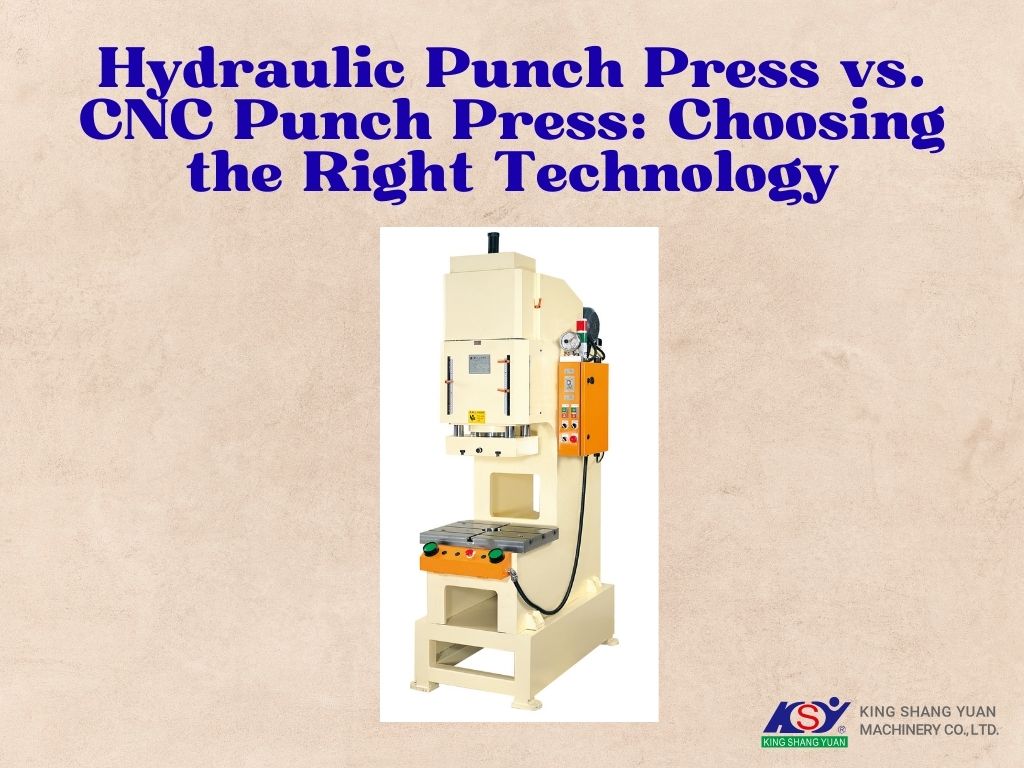
In modern manufacturing and metal processing industries, punching technology plays an essential role in shaping and forming metal components. From automotive parts to hardware components and industrial assemblies, manufacturers rely on punching equipment to maintain productivity and precision.
Two common technologies used in punching operations are the hydraulic punch press machine and the CNC punch press. While both machines perform punching tasks, they are designed for different production environments and manufacturing priorities.
For engineers and factory managers evaluating new equipment, understanding the differences between these two technologies is important. Choosing the right punching solution can significantly affect production efficiency, flexibility, and long-term operating costs.
What Is a Hydraulic Punch Press Machine?
A hydraulic punch press machine uses hydraulic power to generate pressing force. Hydraulic oil pressure drives a cylinder that moves the punch head downward to perform punching, pressing, or forming operations.
One of the main advantages of a hydraulic punch press machine is its ability to deliver smooth and controllable force. Unlike mechanical impact systems, hydraulic presses allow operators to adjust pressure, stroke length, and bottom dead center position according to the requirements of the workpiece.
Because of this flexibility, hydraulic punch presses are commonly used in:
- Metal forming and pressing operations
- Punching thicker materials
- Assembly and press-fit processes
- Hardware and component manufacturing
- Automotive and industrial parts production
In many cases, a hydraulic punch press machine is not limited to punching alone—it can also perform forming and pressing tasks within the same production setup.
What Is a CNC Punch Press?
A CNC punch press integrates punching mechanisms with computer numerical control (CNC) technology. The machine automatically positions sheet metal and performs punching operations according to programmed instructions.
CNC punch presses are designed primarily for sheet metal fabrication and high-speed production environments.
Typical capabilities include:
- Automated sheet positioning
- High-speed repetitive punching
- Complex hole patterns
- Tool libraries and automatic tool changes
- Programmable production sequences
Because the punching pattern is controlled by software, CNC punch presses are extremely efficient when producing large volumes of identical sheet metal parts.
Key Differences Between Hydraulic Punch Press and CNC Punch Press
The following comparison highlights the main differences between a hydraulic punch press machine and a CNC punch press.
| Feature | Hydraulic Punch Press Machine | CNC Punch Press |
|---|---|---|
| Power System | Hydraulic cylinder driven | Servo or mechanical punching system |
| Control Method | Manual or PLC control | Fully CNC programmable |
| Production Focus | Punching, forming, and pressing operations | High-speed sheet metal punching |
| Flexibility | Highly flexible for various forming tasks | Best for repetitive sheet metal patterns |
| Production Environment | Flexible manufacturing lines and assembly processes | Large-volume sheet metal fabrication |
| Typical Applications | Automotive parts, hardware manufacturing, press-fit assembly | Sheet metal fabrication, electrical cabinets, HVAC components |
In general, CNC punch presses are optimized for automated sheet metal production, while hydraulic punch press machines provide greater versatility for forming and pressing operations.
When a Hydraulic Punch Press Machine Is the Better Choice
A hydraulic punch press machine is often the preferred solution when manufacturing requires versatility, controlled pressing force, and adaptability.
Typical applications include:
- Metal component forming
- Press-fit assembly operations
- Punching thicker materials
- Hardware manufacturing
- Automotive component production
- Production lines with multiple forming processes
Hydraulic systems allow operators to control pressure and stroke precisely, making them ideal for processes that require stable motion and repeatable forming results.
Hydraulic punch press machines are also frequently integrated into automated production cells, where they work alongside feeders, robots, and PLC-controlled equipment.
When CNC Punch Press Machines Are More Suitable
CNC punch presses are ideal for industries where production revolves around sheet metal processing and large production volumes.
They are commonly used in:
- Sheet metal fabrication plants
- Electrical cabinet manufacturing
- HVAC component production
- Metal enclosure fabrication
- Electronic equipment housing production
In these environments, CNC punch presses provide exceptional productivity because the machine can automatically position sheets and execute complex punching patterns with minimal operator intervention.
Hydraulic Punch Press Machines in Modern Automated Production
Even with the advancement of CNC punching technology, the hydraulic punch press machine remains an important piece of equipment in many automated production systems.
Hydraulic presses are widely used in applications such as:
- Press-fit assembly lines
- Hardware manufacturing systems
- Automotive component production
- Metal forming operations
- Industrial component punching
Their stable hydraulic motion allows them to integrate smoothly with robotic loading systems, automated feeders, and PLC-controlled production lines.
Because the punching force can be precisely adjusted, hydraulic presses provide reliable performance for forming and pressing operations that require consistent pressure control.
King Shang Yuan Hydraulic Press Solutions
At King Shang Yuan Machinery Co., Ltd., we design hydraulic press solutions that emphasize efficiency, safety, and integration flexibility for modern manufacturing environments.
Our hydraulic punch press machines incorporate several practical features that help manufacturers improve production performance, including:
- Energy-saving hydraulic systems
- Low-noise operation
- Adjustable hydraulic pressure and stroke control
- PLC-based control options
- Dual-button safety operation systems
- Oil temperature cooling systems for stable long-term operation
These design elements allow manufacturers to maintain stable production while ensuring safe and efficient punching operations.
Our AI Type Hydraulic Press series is developed to support punching and pressing operations in both standalone machines and automated production environments.
Conclusion
Both hydraulic punch press machines and CNC punch presses play important roles in modern metal processing industries. However, they are designed for different production priorities.
CNC punch presses excel in high-speed sheet metal fabrication and large-volume production with complex punching patterns. Hydraulic punch press machines, on the other hand, provide greater flexibility, stable pressing force, and adaptability for forming and pressing operations.
For manufacturers evaluating punching equipment, the key is understanding the specific production requirements and selecting the technology that best matches the manufacturing process.
If your production involves forming, pressing, or flexible punching operations, a well-designed hydraulic punch press machine can deliver the stability, control, and reliability needed for long-term manufacturing performance.
FAQ: Hydraulic Punch Press vs CNC Punch Press
What is the main advantage of a hydraulic punch press machine?
The main advantage of a hydraulic punch press machine is its ability to deliver smooth and controllable pressing force. Unlike mechanical punching systems, hydraulic presses allow operators to adjust pressure, stroke length, and bottom dead center position, making them suitable for both punching and forming operations.
Is a hydraulic punch press machine stronger than a CNC punch press?
In many cases, hydraulic punch press machines provide greater pressing force and better control for forming and pressing operations. CNC punch presses, however, are optimized for high-speed sheet metal punching rather than high-force forming processes.
Can hydraulic punch press machines be used in automated production lines?
Yes. Many modern hydraulic punch press machines can be integrated into automated production cells using PLC control, robotic loading systems, and automated feeding equipment. Their stable hydraulic motion makes them suitable for synchronized production environments.
Which punching technology is better for flexible manufacturing?
Hydraulic punch press machines are typically better suited for flexible manufacturing environments. Because pressure and stroke can be easily adjusted, they can handle a wider range of operations such as punching, forming, and pressing.